Toll Violation on Credit Report in Florida: How to Dispute

If you've got a toll violation collection sitting on your credit report in Florida and you're staring at it thinking "I paid that" — stop guessing and start fighting. These entries are messy. They're confusing. And half the time, they're flat-out wrong.
Here's the deal. A missed toll that started as $2.14 somehow became a $187 collection from an agency you've never heard of. Sound familiar?
Let me walk you through how this happens, what it does to your score, and how to attack it the right way.
What You'll Learn
- Why a SunPass or E-PASS toll collection on your Florida credit report is often loaded with billing errors you can legally challenge
- The exact federal law that forces a debt collector to prove the toll debt is yours before it stays on your report
- How toll agencies and their third-party collectors mishandle license plate billing (and why that's your opening)
- A step-by-step dispute plan you can run yourself — free — or hand off to a pro
- The real consequences of ignoring these entries (they don't just disappear)
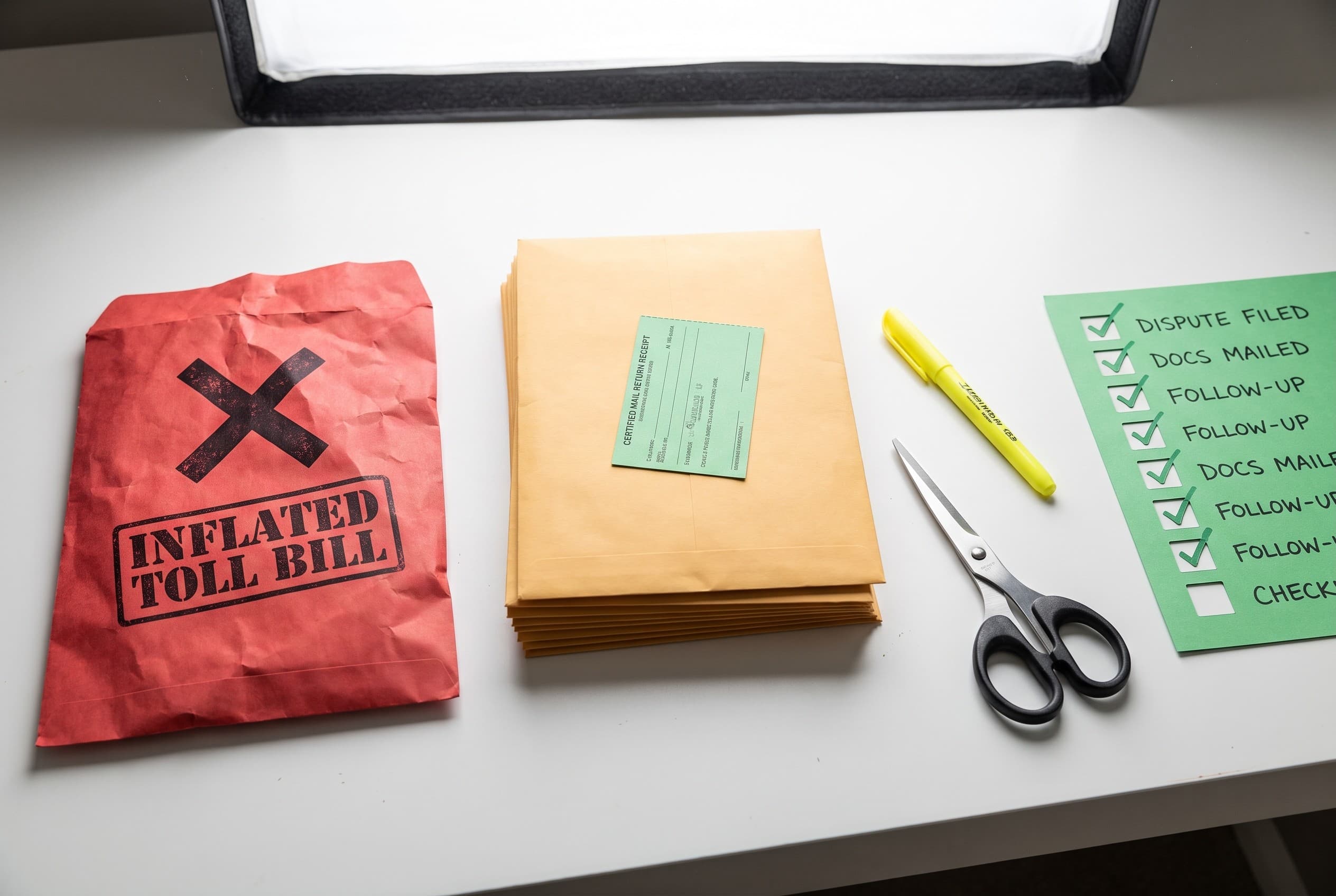
How a $2 Toll Becomes a Collection on Your Credit Report
Florida runs on tolls. SunPass, E-PASS, the Central Florida Expressway Authority, toll-by-plate on 408, 417, 429, the Turnpike — if you drive here, you deal with them. Doesn't matter if you're commuting from Kissimmee to a shift at Disney, running errands in Winter Park, or hauling out to an AdventHealth campus — those cameras don't miss.
Here's where it goes sideways.
You get a toll-by-plate charge because your transponder didn't read, or you drove a rental, or you moved and the bill went to your old address. The toll authority mails a notice. You never see it. They add administrative fees. Then late fees. Then a violation gets tacked on — and in Florida, an unpaid toll-by-plate violation can carry a $25 administrative charge per transaction under the toll authority's rules.
Miss enough of those and the whole mess gets bundled and sold or assigned to a third-party collection agency. That's when it hits your credit report — not as "toll," but as a collection account with some collector's name on it.
And here's the kicker: by the time it lands on your report, the original $2 toll is buried under fees, and nobody's kept clean records of what you actually owed versus what got piled on.
This one drives me crazy. Because the person getting hurt usually did nothing wrong. They just moved, or the plate reader glitched, or SunPass double-billed a transaction.
The "Scare" — What Ignoring It Actually Does
Real talk. A toll collection is still a collection. The credit bureaus don't care that it started as pocket change.
A single collection account can knock a good score down by 50 to 100+ points depending on where you started. I've seen a client in the low 700s drop to the mid-600s over a $140 toll collection — enough to bump their mortgage rate up or get them denied outright.
If you do nothing, here's what's on the table:
- The collection sits on your report for up to 7 years from the date of first delinquency. Seven years. Over a toll.
- Your auto loan and mortgage applications take the hit — lenders see a collection and assume you don't pay what you owe.
- The collector can keep calling and mailing until you either pay or make them prove it.
- In Florida, unpaid toll violations can also stack up at the DMV level and create registration renewal problems that are a whole separate headache.
So no — hiding from the mail doesn't work here. It never does. The people who ignore these letters are the ones who call me a year later with a mess three times as big.
Your Legal Leverage — The FCRA and FDCPA
Now here's where it gets interesting. You're not powerless. Not even close.
When a debt collector reports a toll collection, they have to follow federal law. Two laws are your best friends here.
First — the Fair Debt Collection Practices Act (FDCPA). Under 15 U.S.C. § 1692g, you have the right to demand validation of the debt. One thing to get straight: the FDCPA applies to third-party debt collectors — not the toll authority itself. So this leverage kicks in once SunPass or CFX has handed the account off to a collector. Your 30-day clock runs from when you receive that collector's written validation notice, not just any random phone call. Send a written request inside that window and you force the collector to verify the amount and prove it's actually yours.
Here's the part people mess up: after a timely written validation request, the collector has to pause collection until it mails you verification. Once they mail it, they can resume. And you can still request validation after 30 days — the collector just isn't required to stop while they respond. So don't treat the 30-day mark like a magic off-switch.
This matters a ton with toll debt. Because toll collectors frequently can't show a clean chain of records — the original transaction, the fees added, the notices mailed. It's often a spreadsheet handoff from the toll authority, and the details get lost.
Second — the Fair Credit Reporting Act (FCRA). Under 15 U.S.C. § 1681i, you have the right to dispute any inaccurate or unverifiable item on your credit report. When you dispute, the bureau generally has 30 days to complete its investigation (that can stretch to 45 days if you hand them more documentation mid-process) and force the furnisher — the collector — to verify the account. If it can't be verified as accurate, it has to come off.
One more layer worth knowing: under FCRA § 623, the furnisher (your collector) has its own duty to investigate and report back accurate results. That means you can also fire a direct dispute at the collector with copies of your proof, on top of the bureau dispute. And if you're mailing your disputes with attachments — do it, and keep copies. That paper trail is your evidence if this turns into a fight.
Here's the operator-level detail most people don't know. When you file a dispute, the bureaus run it through an automated system called e-OSCAR. Your dispute gets boiled down to a two- or three-digit code and shot over to the collector. The collector has to respond inside that window. If they blow the deadline, or if they can only "confirm" the account without actually matching the specific data you challenged — balance, dates, original amount — that item is vulnerable. A missed or sloppy reinvestigation isn't a guaranteed auto-delete, but it is a strong basis to escalate — a CFPB complaint, more documentation, or a lawyer.
Toll collections are especially vulnerable because the underlying billing is so error-prone. Wrong plate. Wrong date. Fees that don't add up. A transaction you already paid through your SunPass account.
Let me be straight with you about the CROA rules I work under: I can't promise a deletion, and neither can anyone else — anyone guaranteeing you a removal is lying. What I can tell you is that inaccurate and unverifiable toll entries get challenged all the time, and the law is on your side when the collector can't back up what they reported.

A Real Florida Example — Why "Filed" Doesn't Mean "Owed"
Let me tell you about a client of mine here in Florida, in Downtown Orlando. His problem wasn't a toll — it was an eviction filing — but the lesson is exactly the same, so stick with me.
He'd moved out of a Downtown Orlando apartment complex voluntarily. Paid every dollar of rent he owed. Clean exit. But the complex had filed an eviction earlier during a dispute and never dismissed it. So there it sat — a public record eviction filing showing up on his tenant screening reports through LexisNexis, wrecking his ability to rent anywhere.
The filing existed. But it was never adjudicated. He never lost. The record was inaccurate as reported because it implied an outcome that never happened.
Here's what we did: got the landlord to confirm in writing that all rent was paid and the matter was resolved. Then disputed the public record with the documentation. It came off LexisNexis and his tenant screening reports.
Why does this matter for your toll problem? Because a toll violation showing up as a collection is the same trap. Something got "filed" or "assigned" — but that doesn't mean the amount is accurate or that it's even properly yours. You attack it the same way: get the paper that proves the truth, then dispute the inaccurate version.
That's the whole game. Documentation beats assumptions. Every time.
The Action Plan — How to Dispute a Toll Violation Collection in Florida
OK so here's your step-by-step. You can run this yourself for free (yes, really — you don't legally need to pay anyone), or you can hand it off. Either way, follow the order.
Step 1 — Pull all three credit reports
Get your reports from Equifax, Experian, and TransUnion at AnnualCreditReport.com — it's free. Find the toll collection. Write down the collector's name, the exact balance, the account number, and the "date of first delinquency."
Check whether it's on all three bureaus or just one. That tells you where to aim.
Step 2 — Get your toll account history
Log into your SunPass or E-PASS account (or call the toll authority). Pull the transaction history for the dates in question. You're looking for:
- Did you actually cross that toll point?
- Was the transponder charged already?
- Do the fees match what the collector claims?
- Was the bill mailed to an old address?
Any mismatch here is ammunition.
Step 3 — Send a debt validation letter to the collector
Within 30 days of receiving the collector's written validation notice — and honestly, even after — send a written validation request under FDCPA § 1692g. Make them prove the debt: the original toll amount, the itemized fees, and proof the account is yours.
Send it certified mail, return receipt requested. I can't stress this enough. The green card is your proof they got it and when. In a dispute fight, that timestamp is worth its weight in gold.
Step 4 — Dispute with the bureaus
File an FCRA dispute under 15 U.S.C. § 1681i with each bureau reporting the account. Be specific. Don't just say "not mine." Say what's wrong — the balance is inflated, the toll was already paid, the dates don't match, the fees are unverifiable. Attach your SunPass records. Mail it if you can, so your documentation is part of the record and you keep copies.
Want to double up? Send a direct dispute to the collector too — under FCRA § 623 they've got their own duty to investigate what you send them.
Specific disputes are harder for the collector to rubber-stamp through e-OSCAR.
Step 5 — Watch the 30-day clock
The bureau generally has 30 days to complete its investigation (up to 45 if you feed them more documents along the way). If the collector can't verify the specific inaccuracies you flagged, the item has to be corrected or removed. If it comes back "verified" but you know it's wrong, don't quit — escalate with more documentation, a CFPB complaint, or professional help.
That's exactly the kind of stubborn, documented back-and-forth we handle at Freedom Credit Repair. We know what a toll collector's records usually don't have, and we push on those gaps. Removing inaccurate and unverifiable collection accounts is our bread and butter — [see how our collections work here](collections removal).
We've helped folks all over the state with this exact issue — from Kissimmee and Winter Park commuters to the crews out near the Disney and AdventHealth corridors. Check out our FAQ for the questions we get most, and if you're local, our [Florida credit repair page](credit repair across Florida) and [Orlando team](credit repair in Orlando) are ready to dig in.
Don't Let a $2 Toll Cost You a House
Bottom line — a toll violation collection is one of the most disputable items I see, precisely because the billing behind it is so sloppy. But it won't fix itself. You've got to demand validation, dispute the inaccuracies, and keep receipts.
You can do it yourself for free. Or if you're staring at a report that makes no sense and you want someone in your corner who fights this every single day — call us.
Talk to a Real Credit Specialist — Free
The fastest way to get straight answers about your situation in Orlando and across Florida.
4.9 · 89 Google reviews · No upfront fee
Call (407) 606-7117Individual results vary. We help you dispute inaccurate, unverifiable, or outdated items — no one can remove accurate, current information from your credit report, and you can dispute it yourself for free with the bureaus.
Call Freedom Credit Repair at (407) 606-7117. We work with clients across Florida and nationwide by phone. Let's look at what's actually on your report and build a plan to challenge what doesn't belong there.
Frequently Asked Questions
Can a SunPass or toll violation really show up on my credit report in Florida?
Yes — but typically only after it's been sent to a third-party collection agency. Toll authorities like SunPass, E-PASS, and CFX generally don't furnish unpaid tolls directly to the credit bureaus the way a lender does. Once the unpaid toll and its added fees get assigned or sold to a debt collector, that collector can report it as a collection account, which is what tanks your score. Worth checking who's actually listed as the furnisher on your report — that tells you who you're really fighting.
How do I dispute an unpaid toll collection on my Florida credit report?
File a dispute under the FCRA with each credit bureau reporting the account, and be specific about what's inaccurate — the balance, the dates, or whether it's even yours. Pull your SunPass or E-PASS transaction history to prove errors, and send a debt validation letter to the collector under the FDCPA demanding they verify the amount. You can also send a direct dispute to the collector under FCRA § 623. If the collector can't verify the specific inaccuracies within the bureau's investigation window, the item must be corrected or removed. You can do this yourself for free at AnnualCreditReport.com.
How long does a toll collection stay on my credit report?
A toll collection can stay on your credit report for up to seven years from the date of first delinquency — the same as most collection accounts under the FCRA. Paying it doesn't automatically reset or remove it, which is why disputing an inaccurate or unverifiable entry is often the smarter first move.
The toll was only a few dollars — why is the collection over a hundred?
Because Florida toll authorities add administrative charges, late fees, and per-transaction violation fees on top of the original toll. A $2 toll can balloon into a triple-digit balance by the time it reaches collections. Those stacked-up fees are frequently where the billing errors hide, which makes the inflated balance one of the easiest things to challenge.
Do I need a credit repair company, or can I dispute the toll myself?
You can absolutely dispute a toll collection yourself for free — it's your legal right under the FCRA, and no company can do anything you can't do on your own. Where a pro helps is when the collector keeps "verifying" an entry you know is wrong, when it's on multiple bureaus, or when you don't have time to run the certified-mail and follow-up process. If you'd rather hand it off, that's what we're here for.
Can unpaid tolls affect my car registration in Florida?
Yes. Separate from your credit report, unpaid toll violations in Florida can create problems at the DMV level, including holds that interfere with registration renewal. That's a different track from the credit reporting issue, but both can stem from the same missed toll — so it's worth resolving the underlying toll account, not just the credit entry.

Matt Brody
Founder, Freedom Credit Repair
Matt is the founder of Freedom Credit Repair based in Orlando, FL. Since 2019, Matt has helped clients remove negative items from their credit reports and take control of their financial future. Call (407) 606-7117 for a free consultation. More about Matt →