Florida Debt Buyer Lawsuit & Your Credit Report: Check This First

If you just got served with a lawsuit from a company you've never heard of — Midland Credit, Portfolio Recovery, LVNV Funding, Cavalry — over a debt you barely remember, don't sign anything yet. And whatever you do, don't ignore it.
That's the fastest way to lose.
Here's the thing. A debt buyer suing you in Florida is playing a numbers game. They bought your old debt for pennies on the dollar — sometimes 4 cents on the dollar, I've seen the portfolio spreadsheets — and they're betting you won't show up to court. When you don't show, they get a default judgment. Then they come after your bank account and your wages.
But when you DO show up, and you know what to check first, the whole thing changes. I've watched these cases fall apart because the debt buyer couldn't prove they even owned the debt.
Let me coach you through this.
What You'll Learn
- The federal law that forces a debt buyer to actually PROVE they own your debt — and the 30-day window where it matters most
- Why a Florida debt could be legally dead even if it's real (and how to spot it)
- The exact documents a debt buyer almost never has when they file — and how that becomes your leverage
- What that collection account is doing to your credit report right now, and why the lawsuit and the credit damage are two separate fights you have to win
- A step-by-step response plan so you never, ever hand them a default judgment
First, Understand Who's Actually Suing You
Real talk — the company suing you probably isn't the bank you originally owed.
When you default on a credit card or a loan, the original creditor eventually writes it off as a loss (that's the "charge-off" you see on your credit report). Then they bundle thousands of these dead accounts and sell the whole bundle to a debt buyer for a tiny fraction of face value.
The debt buyer now owns your $4,200 balance that they paid maybe $170 for. Their business model? Sue a bunch of people, win most cases by default because folks don't respond, and collect on the judgments.
Know what the worst part is? Half the time, when they buy these portfolios, they don't get the actual paperwork. No signed contract. No complete payment history. Just a spreadsheet with your name, a number, and a balance. That gap is where you fight.
What Happens If You Do Nothing (The Scare)
I need you to understand this part, because this is the mistake I see over and over.
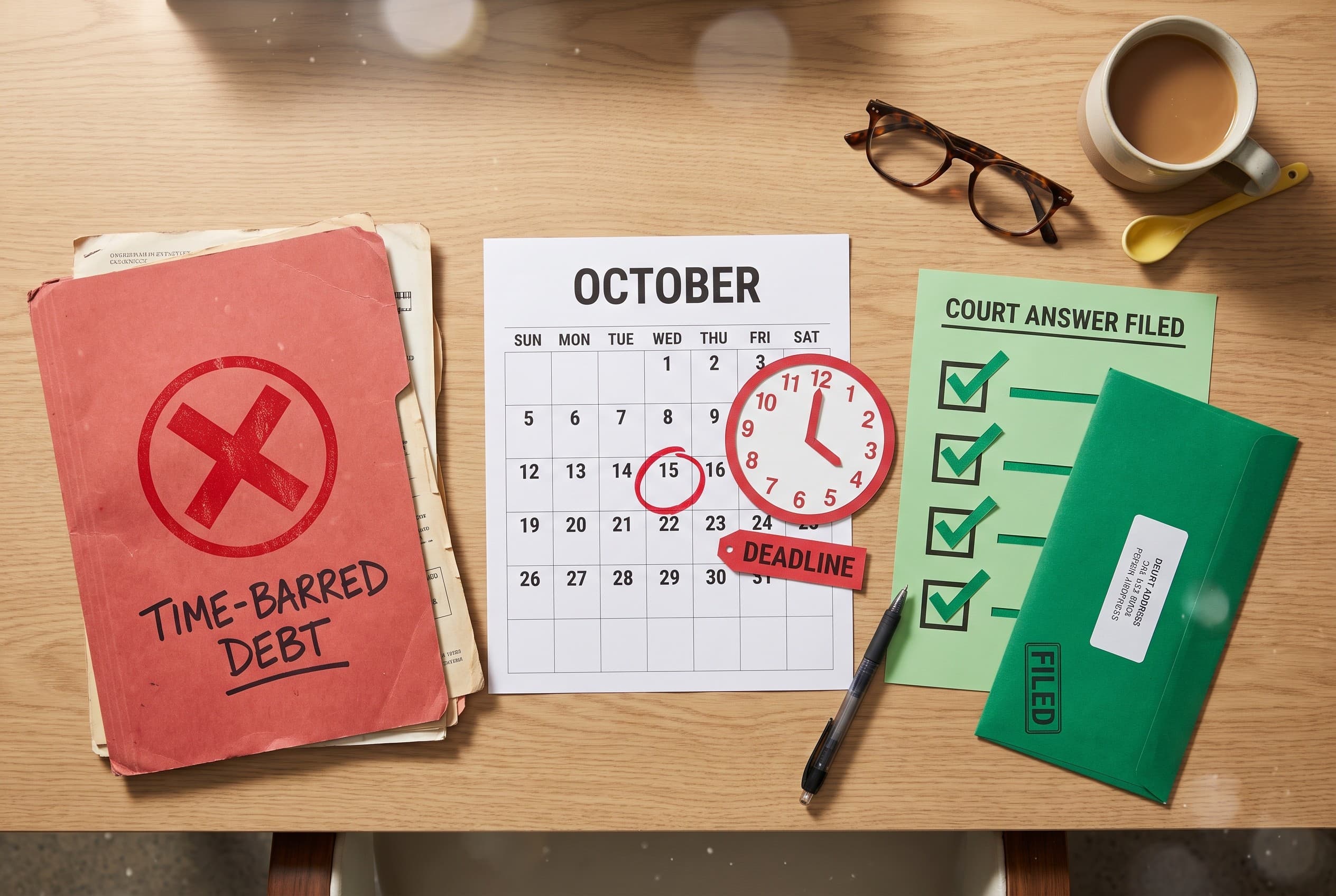
In Florida, once you're served, the clock starts. You generally have 20 days to file a written response with the court (that's standard for county civil court — the summons will tell you the exact deadline). Miss it, and the debt buyer files for a default judgment.
A default judgment means you lose without ever telling your side. Then what?
- Wage garnishment. Florida does allow it. (More on the one big exception in a second.)
- Bank account freeze. They can get a writ of garnishment and freeze your account.
- A judgment on your public record that follows you around and can show up on tenant screening and background checks for years.
- Interest piling on at the Florida statutory judgment rate.
Now here's the Florida-specific good news most people don't know. Florida has a head-of-household exemption under Fla. Stat. § 222.11. If you provide more than half the support for a child or dependent, your wages — up to $750 a week in disposable earnings, and sometimes above that — can be completely protected from garnishment. And Florida's homestead protection means they generally can't touch your primary home.
But — and this matters — you have to claim those exemptions. They don't apply automatically. If you ignore the lawsuit, you may never get the chance to raise them. That's why showing up is everything.
Your Legal Leverage: The 5 Things to Check Before You Respond
Before you respond to the lawsuit, before you call the debt buyer, before you panic — check these.
1. Is the Debt Time-Barred? (Florida Statute of Limitations)
This is the big one. Florida has a statute of limitations on debt, and once it passes, the debt buyer can still try to sue you — but you have an absolute defense if you raise it.
For most written contracts (like a credit card agreement), Florida's statute of limitations is five years under Fla. Stat. § 95.11. The clock generally runs from the date of your last payment or last activity — not from when the debt buyer bought it.
So if you stopped paying a credit card in early 2020 and a debt buyer is suing you in 2026? That debt may be time-barred.
But listen carefully — this is a defense you must raise in your written answer. A Florida judge isn't going to throw out a time-barred case for you. If you don't plead it as an affirmative defense, you waive it. I've seen people with a dead debt lose simply because they didn't say the magic words in their response.
Here's another angle worth knowing: when a debt buyer sues or tries to collect on a debt they know is time-barred — especially if they act like it's still fully enforceable — that behavior can actually violate the FDCPA and Florida's own Consumer Collection Practices Act (Fla. Stat. § 559.72) depending on the facts. If your dates show the thing is dead, that's exactly the kind of situation where a Florida consumer attorney can turn the tables on them.
Critical warning: Do NOT make a payment or even verbally promise to pay on an old debt before you check the dates. In some situations a new payment can restart the clock. Debt buyers know this — that's why the friendly "let's just set up a small monthly plan" call can be a trap.
2. Can They Actually Prove They Own the Debt?
Here's where debt buyer cases collapse.
To win, the debt buyer has to prove the complete chain of title — that your debt went from the original bank, through any middlemen, to them. They need the bill of sale, the assignment documents, and proof your specific account was included in the sale.
A lot of times? They've got a generic bill of sale that doesn't even mention your account by name. When you demand they produce the actual signed agreement and a full accounting — through the court's discovery process — they come up empty.
No proof of ownership, no case.
3. Did You Demand Debt Validation?
Under the federal Fair Debt Collection Practices Act — specifically FDCPA § 1692g — you have the right to demand debt validation. Within 30 days of their first contact, you can send a written request forcing them to verify the debt, the amount, and that they have the right to collect. Send that request in time, and they're supposed to pause collection activity until they mail you the validation.
The CFPB explains your debt validation rights here, and they even provide sample letters.
But understand what validation is and isn't. It's a pre-lawsuit collection tool — a way to make them put up or shut up before things get to court, and it builds your paper trail. It is NOT the same as forcing them to prove ownership inside the lawsuit. Once you're actually being sued, the real pressure on chain of title comes through the court's discovery process and the evidence rules — that's where you make them produce the signed agreement and the full accounting. If you're past the 30-day window or already in litigation, that's your lane. If they can't validate before the lawsuit, that's still ammunition.
4. Is the Amount Even Right?
Debt buyers tack on interest and fees as the account passes hands. I've seen a $2,800 original balance balloon to $5,100 by the time it hits a lawsuit. Make them itemize every dollar. Half the time the math doesn't hold up.
5. What Is This Doing to Your Credit Report?
This is the part people forget in the middle of a lawsuit panic. The lawsuit and your credit report are two separate battles.
That collection account — and the original charge-off — are sitting on your credit report right now, dragging your score down. Even if you beat the lawsuit, the negative item doesn't automatically disappear. And if there's a judgment, that's a whole separate public-record problem.
So while you're fighting the lawsuit, you also need to review the credit report entry for inaccuracies: wrong balance, wrong dates, or an account that's past the 7-year reporting window. Watch the double-reporting angle too — it's legal for both the original creditor AND the debt buyer to have a tradeline, but they can't both show you still owe the same balance as if it's two separate debts. After a sale, the original creditor should typically show a $0 balance (sold/transferred), and the collector shouldn't be inflating or duplicating the amount. Any of those is grounds for a collection account credit report dispute under the FCRA. That's where our collections removal work comes in — attacking the inaccurate reporting, not the lawsuit itself.

A Quick Story About Dead Public Records
Let me show you why checking the record matters, because it's not just about debts.
I had a client in Downtown Orlando a while back who got blindsided — not by a debt buyer, but by an eviction filing on his record. Here's the kicker: he'd moved out of his apartment complex voluntarily and paid every dollar of rent he owed. The complex had filed the eviction paperwork early in the process and then just... never dismissed it after he paid and left.
So the filing sat there. Never adjudicated. Never resolved. But it showed up on his tenant screening reports and was torpedoing every apartment application he submitted.
Same principle as a debt buyer lawsuit: a record existed on paper that didn't reflect reality.
We got the landlord to confirm in writing that all rent had been paid and nothing was owed. Then we disputed the public record with the documentation. The result? It came off his LexisNexis file and his tenant screening reports.
Why does this matter for your debt buyer case? Because the lesson is identical: a filing is not a final judgment, and a record on your report isn't automatically accurate. Debt buyers file lawsuits that never get fully litigated all the time. If you respond and fight, a lot of these cases get dropped or dismissed — and then you make sure your credit report reflects that reality too.
The Action Plan: Responding to a Florida Debt Buyer Lawsuit
OK, here's your step-by-step. Follow it in order.
-
Find your deadline. Read the summons. Note the exact number of days you have to respond (usually 20 in Florida county civil court). Put it on your calendar in red.
-
Don't call them and don't pay anything yet. No payments, no promises, no "let me set up a little plan." Not until you've checked the statute of limitations.
-
Pull your dates. Find the date of your last payment on the original account. That date determines whether the debt is time-barred under Florida's five-year rule.
-
File a written answer with the court — on time. Deny what you don't know to be true, and raise your affirmative defenses in writing: statute of limitations (if it applies), lack of standing/ownership, and failure to state the amount. If you don't plead it, you lose it.
-
Make them prove it. Through the court process, demand the full chain of title, the signed agreement, and a complete accounting. Many debt buyers can't produce it.
-
Claim your exemptions. If you're head of household, assert the Fla. Stat. § 222.11 wage exemption. Don't assume it protects you automatically — put it in writing.
-
Attack the credit report separately. Pull all three reports. Check the collection entry for wrong balances, wrong dates, double-reporting, or anything past the 7-year window. Dispute inaccuracies with the bureaus. You can do this yourself for free — or get help if it's tangled up with the lawsuit.
-
Get documentation of any resolution in writing. If the case gets dismissed or you settle, get it IN WRITING, just like we did with that landlord in Downtown Orlando. Then use it to clean up your report.
A quick note on step 4 and 5: I'm not a lawyer and this isn't legal advice. For the actual court filing, especially on a larger balance, talk to a Florida consumer attorney — many take these cases cheap or on contingency because the FDCPA (and the FCCPA) let them recover fees from the debt buyer. What I handle is the other half of the fight: your credit report.
Where Freedom Credit Repair Fits In
Look, I'm going to be straight with you. We don't go to court for you — that's a lawyer's job, and you should get one if you're being sued.
What we do at Freedom Credit Repair is handle the credit report side of this mess. The inaccurate collection accounts. The double-reported balances. The outdated entries that should have aged off. The public records that don't reflect what actually happened. We work with clients all over Florida — from the panhandle down to Miami — by phone, and we know the Florida process cold. If you want the full rundown on how we work, check out our FAQ.
We can't promise to delete accurate, verifiable debts — nobody legitimate can, and anyone who does is lying to you. What we CAN do is review your report line by line, find the inaccuracies, and dispute them on your behalf. If you're a Florida resident caught in a debt buyer lawsuit and watching your score tank at the same time, let's talk about the credit piece while your lawyer handles the courtroom. Learn more about our Florida credit repair services.
Talk to a Real Credit Specialist — Free
The fastest way to get straight answers about your situation in Orlando and across Florida.
4.9 · 89 Google reviews · No upfront fee
Call (407) 606-7117Individual results vary. We help you dispute inaccurate, unverifiable, or outdated items — no one can remove accurate, current information from your credit report, and you can dispute it yourself for free with the bureaus.
Stop letting a debt buyer run the clock on you. Call Freedom Credit Repair at (407) 606-7117 and let's get the credit side of this fight handled — today.
Frequently Asked Questions
Can a debt buyer sue me in Florida for an old debt?
Yes, a debt buyer can file a lawsuit in Florida even on an old or time-barred debt — but if the debt is past Florida's statute of limitations (generally five years for written contracts under Fla. Stat. § 95.11), you have a complete legal defense. The catch is that you must raise the statute of limitations as an affirmative defense in your written answer to the court. If you ignore the lawsuit or don't plead it, you waive the defense and they can get a default judgment against you. And heads up — suing or collecting on a debt they know is time-barred can itself violate the FDCPA and Florida's FCCPA, so a consumer attorney may be able to flip that against them.
What is time-barred debt in Florida?
Time-barred debt in Florida is a debt that's past the statute of limitations — meaning the creditor or debt buyer can no longer win a lawsuit to force you to pay it, as long as you raise the defense. For most written contracts like credit cards, that limit is five years from your last payment or activity. Important: making a new payment or even acknowledging the debt in writing can restart the clock, so never pay or promise to pay an old debt before confirming the dates.
How long do I have to respond to a debt buyer lawsuit in Florida?
You generally have 20 days from the date you're served to file a written response in Florida county civil court, but check your summons for the exact deadline. Missing it lets the debt buyer file for a default judgment, which can lead to wage garnishment or a frozen bank account. File a written answer on time, even if all you do is deny the claims and raise your defenses.
Will beating the lawsuit remove the collection from my credit report?
No, winning or dismissing a debt buyer lawsuit does not automatically remove the collection account from your credit report — they're two separate issues. Even after the case ends, the negative item can remain unless it's inaccurate, unverifiable, or past the 7-year reporting window. You have to separately dispute the credit report entry under the FCRA, which you can do yourself for free with the bureaus or with help from a credit repair company.
Can debt buyers garnish my wages in Florida?
Yes, if a debt buyer gets a judgment they can seek wage garnishment in Florida — but Florida's head-of-household exemption under Fla. Stat. § 222.11 can fully protect the wages of anyone who provides more than half the support for a dependent. You must formally claim the exemption; it isn't applied automatically. Florida's homestead protection also generally shields your primary residence from these judgments.

Matt Brody
Founder, Freedom Credit Repair
Matt is the founder of Freedom Credit Repair based in Orlando, FL. Since 2019, Matt has helped clients remove negative items from their credit reports and take control of their financial future. Call (407) 606-7117 for a free consultation. More about Matt →