Credit Repair After Repossession: Rebuild the Right Way

If the repo already happened, stop replaying it in your head. The tow truck came, the car's gone, and now your score looks like it got hit by a bus. I get it.
But here's the thing — the repossession itself isn't the only thing dragging you down. It's everything AROUND it that's usually wrong. And that's where you actually have leverage. Credit repair after repossession isn't about erasing what's true — it's about attacking every inaccurate detail attached to it.
Let me show you where the fight is.
What You'll Learn
- Why the repossession on your report is almost never reporting cleanly — and what that means for you
- The exact federal law that forces a lender to prove what they're claiming (or correct it)
- The one balance that keeps haunting people for years after the car's gone (and how to attack it)
- How folks get approved for a car loan again after a repo — sometimes faster than they'd guess
- Where DIY disputes stop working and a phone call saves your sanity
Real Talk — A Repo Is Bad. Doing Nothing Is Worse.
So what actually happens if you just let this sit?
The repossession lands on your credit report and stays there for seven years from the date of the first missed payment that led to it. Seven. That's real. But that's not even the part that ambushes people.
The part that ambushes people is the deficiency balance.
Here's how that works. The lender takes your car, sells it at auction — usually for way less than you owed — and then bills you for the difference. You owed $18,000, they auctioned it for $9,000, and now they want the remaining $9,000 plus fees. That's the deficiency balance after a repo, and it doesn't just disappear.
When you ignore it, that balance often gets sold to a collection agency. Now you've got TWO negative marks: the repo AND a collection. Ignore that, and the collector can sue. Win a judgment, and depending on your state, you're looking at wage garnishment or a bank levy.
I had a client last year who thought the repo was "handled" because he'd stopped getting calls. The calls stopped because the debt got sold. Eighteen months later he got served. Don't be that guy.
How to Dispute a Repossession on Your Credit Report
Now here's where it gets interesting.
After years of doing this, I can tell you most repossessions do NOT report accurately. The furnishers — that's the lender or the collection agency — mess up the details constantly. And every wrong detail is something you can legally challenge.
What I see wrong all the time:
- Wrong balance. They report the full original loan amount instead of the deficiency after auction.
- Wrong dates. The date of first delinquency is off, which can illegally extend how long it stays on your report.
- Double reporting. The original lender AND the collection agency both report the same debt as separate open balances. That's tanking your score twice for one debt.
- Status errors. It shows "open" when the account was charged off, or "repossession" when you actually did a voluntary surrender.
- Balance still showing after settlement. You paid or settled and it still reads like you owe.
Every one of those is inaccurate information. And under the Fair Credit Reporting Act, you have the right to dispute anything on your report that's inaccurate, incomplete, or unverifiable.
Here's the mechanism. When you dispute, the bureau has to run a reasonable reinvestigation — usually within 30 days — under FCRA § 1681i. They send your dispute to the furnisher through an automated system. And here's the other side of that — under FCRA § 623, the furnisher has its own legal duty to report accurately and to investigate the disputes bureaus forward to them. So the furnisher has to check their records and confirm the info. If they find it's inaccurate or incomplete, they have to correct it. If they can't verify it, or they don't respond in time, it has to come off.
And real talk — a lot of these debts have been sold two or three times. The third collection agency that bought your deficiency balance for pennies often doesn't have the original loan agreement, the auction records, or the accounting to prove what they claim. When they can't produce it, they can't verify it — and that's when the dispute goes your way. (I'll be straight with you: a debt getting sold a bunch of times doesn't automatically delete anything. What it does is make accurate verification harder for them, which is where your leverage lives.)
That's not a loophole. That's the law doing exactly what it's supposed to do.
The collection side of the debt
If a collector's involved, you've got a second tool. Under FDCPA § 1692g, if you send a debt validation letter in writing within 30 days of their first contact, they have to stop collecting until they mail you verification of the debt. Now, "verification" can be pretty thin — sometimes it's just a statement of the amount and who they say you owe, not the full contract and auction file. So don't expect a golden ticket here.
But here's why it still matters: if what they send doesn't line up with your records — wrong amount, wrong owner, wrong anything — you take that straight into an FCRA dispute on the accuracy. And under FDCPA § 807, a collector can't make false or misleading representations about the debt — the amount, its legal status, or what they'll do to you. Catch them doing that, and you've got real leverage.
You'd be surprised how many just… go quiet.

How a Wrong Collection Can Wreck You — and Come Off
Let me show you why documentation is everything, with a story that isn't even about a car.
I had a client in Apopka who got into a minor fender-bender — a nothing accident. Fire rescue showed up, and he refused the ambulance ride right there at the scene. Told them flat out, no transport, I'm fine. Signed nothing agreeing to a ride.
Three weeks later? A $1,900 bill from the fire rescue service. For a transport he refused. He didn't pay it, figured it was a mistake, and it went straight to collections. That single collection dropped his score 90 points.
Here's what we did. We didn't just dispute it as "not mine." We pulled the incident documentation showing he refused transport, and we challenged the accuracy of the charge itself. The charge was for a service he never received — and under the FCRA's accuracy requirements, a collection reporting a bill you don't owe has no leg to stand on. It came off.
Why does this matter for your repo? Same exact principle. Documentation beats a debt collector every time. A deficiency balance reported with the wrong number, a collection with no paper trail, a date that doesn't match your records — when you bring proof and cite the accuracy requirement, they either fix it or delete it.
That's the whole game. Getting a wrong collection removed isn't magic. It's forcing the other side to prove their claim, and they usually can't.
The Action Plan: Rebuild Credit After a Repo
OK, so here's your battle plan. Follow it in order.
Step 1: Pull all three reports
Get your reports from all three bureaus — Experian, Equifax, TransUnion — free at AnnualCreditReport.com. The repo may report differently on each one. You dispute where it's wrong, on each bureau it's wrong.
Step 2: Audit the repo line by line
Compare what's reported against your actual loan paperwork. Check the balance, the date of first delinquency, the account status, and whether the same debt shows up twice. Write down every discrepancy. These are your disputes.
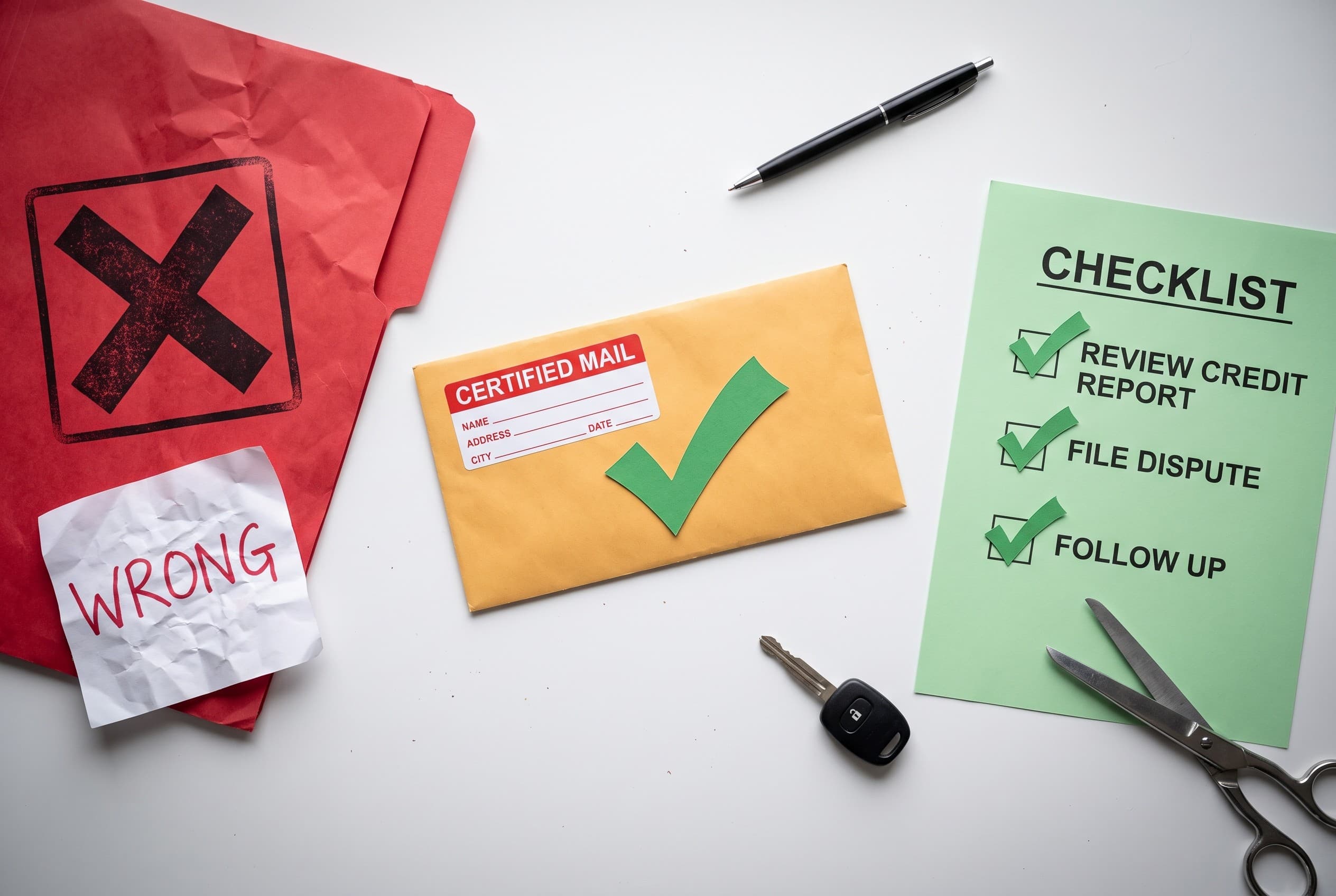
Step 3: Dispute the inaccuracies — in writing, certified mail
Don't use the online dispute portals for anything complicated. Here's an operator detail most people don't know: the bureaus route online disputes through an automated system (e-OSCAR) that boils your whole argument down to a two- or three-digit code. Your documents and explanation often never reach a human.
Mail it. Certified, return receipt requested. Now you've got a dated paper trail and proof they received it — which matters a lot if this ends up in a lawsuit. Keep copies of everything.
Step 4: Validate the collection
If there's a deficiency balance in collections, send that debt validation letter under the FDCPA within 30 days of their first contact. That forces them to stop collecting until they mail verification. Then check what they send against your records — no match on the amount or the owner, and you've got an accuracy dispute.
Step 5: Stop the bleeding on your active accounts
While you're fighting the repo, protect what's left. Every account you keep current is quietly rebuilding you. Two things I put nearly every client on:
- A secured credit card. Put down $200-$500, use it for gas and groceries, pay it in full every month. This builds new positive history fast.
- Get your utilization under 30%. If your cards are maxed, that alone is crushing your score. Pay them down before you pay down anything else.
Step 6: About that next car loan
Here's the honest version of "get a car loan after repossession." You can — people do it all the time — but the terms right after a repo are ugly. High interest, big down payment.
My advice? If you can go 6-12 months rebuilding first, do it. Every dispute that clears an inaccurate mark and every on-time payment moves you toward better terms. When you do finance, a credit union is almost always kinder to a rebuilding borrower than a buy-here-pay-here lot that'll bury you in 24% interest.
Where We Come In
Look, you can do every step above yourself, for free, and some people should. If you've got one clean error and the time to chase it, go get 'em.
But most people who call me are staring at a repo, a deficiency collection, maybe a second collection that got sold, and a hard clock — they need a car or an apartment now. The paperwork is overwhelming solo, and one wrong move on a dispute can cost you weeks you don't have.
That's what we do at Freedom Credit Repair. We audit your reports, find every inaccurate and unverifiable item tied to the repo, and run the disputes the right way — so you're not guessing. We can't promise a specific score, a specific timeline, or that any accurate debt disappears (nobody legally can — and anyone who does is lying to you). What we can do is make the furnishers prove what they're claiming. Our whole repossession credit recovery process is built around exactly that.
Got questions before you call? Check our FAQ — we answer the ones people ask most.
We work with clients nationwide by phone. Call (407) 606-7117 and let's build your plan.
Talk to a Real Credit Specialist — Free
The fastest way to get straight answers about your situation in Orlando and across Florida.
4.9 · 89 Google reviews · No upfront fee
Call (407) 606-7117Individual results vary. We help you dispute inaccurate, unverifiable, or outdated items — no one can remove accurate, current information from your credit report, and you can dispute it yourself for free with the bureaus.
Frequently Asked Questions
How long does a repossession stay on your credit report?
A repossession stays on your credit report for seven years from the date of your first missed payment that led to the repo — not from the date the car was actually taken. This is set by the FCRA. If a lender or collector reports a date that's later than your true date of first delinquency, they're illegally extending how long it damages you, and you can dispute that error.
Can I dispute a repossession on my credit report?
Yes — you can dispute any repossession entry that's inaccurate, incomplete, or unverifiable under the FCRA. You cannot legally erase an accurate, verified repossession, but in my experience most repos report with at least one error: a wrong balance, a wrong date, double reporting, or a status that doesn't match what actually happened. Each of those is a legitimate dispute. If the furnisher can't verify the disputed information within about 30 days, it has to be corrected or removed.
What is a deficiency balance after a repo?
A deficiency balance is what you still owe after the lender sells your repossessed car and applies the proceeds to your loan. If you owed $15,000 and the car auctioned for $8,000, the $7,000 difference is the deficiency balance. Lenders can pursue this amount, and it's often sold to a collection agency — which can create a second negative mark. Always verify the collector actually owns the debt and that the amount is accurate before you pay a dime.
Can I get a car loan after a repossession?
Yes, you can get a car loan after a repossession, though the terms right after are usually rough — higher interest and a larger down payment. Your approval odds and rates improve as you clear inaccurate marks and add on-time payment history. Waiting 6-12 months to rebuild first, then applying through a credit union, typically gets you far better terms than financing immediately at a buy-here-pay-here lot.
How fast can credit repair after repossession work?
There's no guaranteed timeline — anyone who promises one is breaking the law. That said, the FCRA gives bureaus about 30 days to investigate a dispute, so inaccurate items that can't be verified may come off within a month or two of a properly filed dispute. Accurate items won't come off through disputing; those improve only with time and new positive history. Real recovery is usually a combination of removing what's wrong and rebuilding what's right.

Matt Brody
Founder, Freedom Credit Repair
Matt is the founder of Freedom Credit Repair based in Orlando, FL. Since 2019, Matt has helped clients remove negative items from their credit reports and take control of their financial future. Call (407) 606-7117 for a free consultation. More about Matt →