Car Loan Denied Because of Collections? Read This First

What You'll Learn
- The one letter the lender's legally required to send you after a denial — and why it's your cheat sheet (most people toss it in the trash)
- The exact federal law that forces collection agencies to report your info accurately — not just slap on whatever code they feel like
- Why hitting three dealerships in one week can actually make things worse
- A real client story where one wrong reporting code cost 40 points — and how we clawed most of it back
So They Said No. Now What?
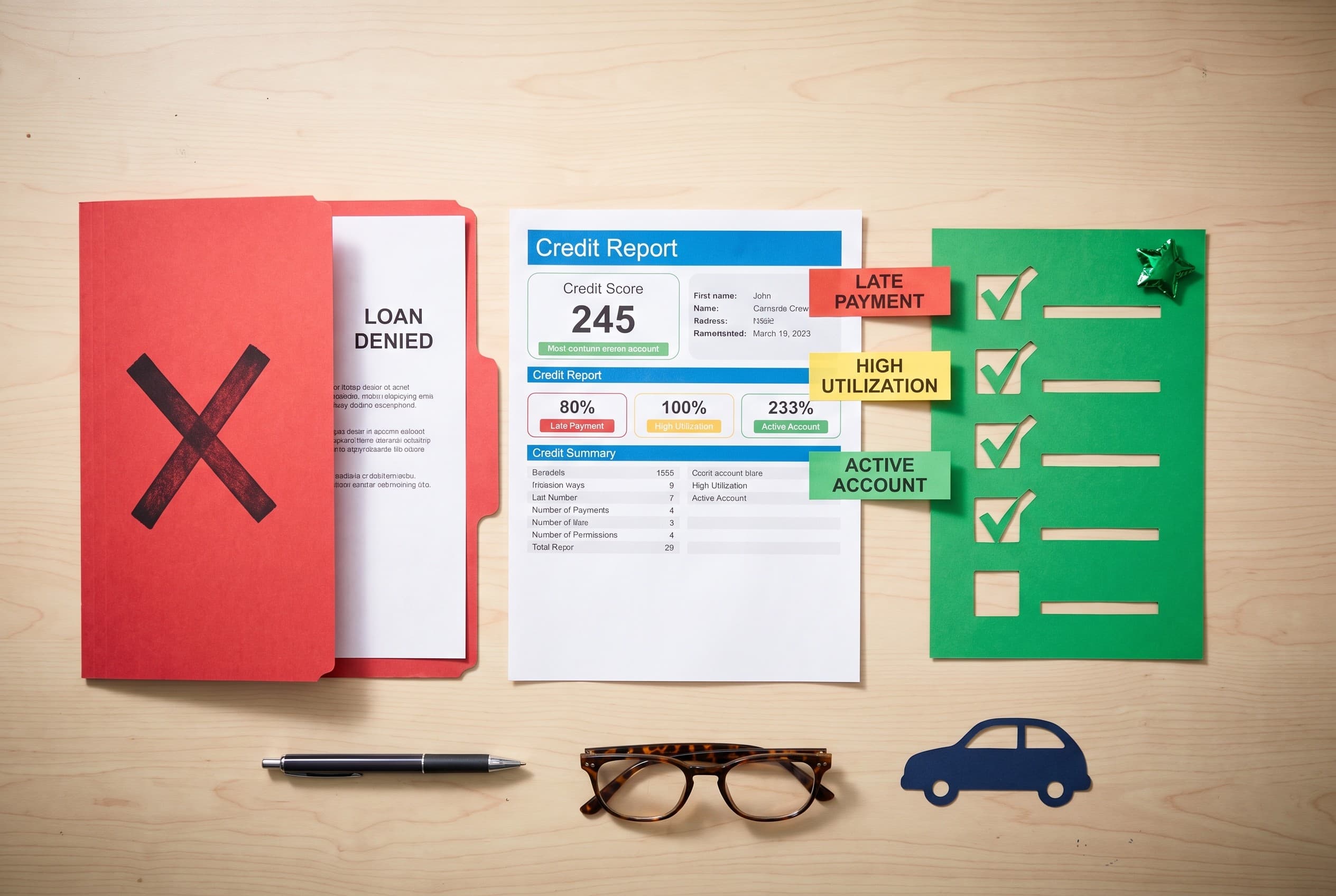
If a dealer or bank just denied your car loan over collections, stop. The collection agency then has to check its records and respond inside that 30-day window. Not yet.
I know the pressure you're under. You need the car for work, for your kids, for your whole life. But reapplying blind — before you understand why you got denied — is how folks dig the hole deeper.
Here's the thing most folks don't get: a denial isn't always about you owing money. Sometimes it's about a mistake on your report. And mistakes? Those are fixable.
I've been doing this since 2019, and honestly, the number of auto-loan denials I've seen tied to flat-out wrong collection entries would make your head spin. Wrong balances. Debts listed twice. Accounts that should've fallen off years ago. A collection agency reporting something they can't even prove.
So before you reapply, you're gonna do a little homework. It's not hard. Let's go.
What Actually Happens If You Just Keep Reapplying
Real talk — I get why the instinct is to shop around. But let me walk you through what happens when you ignore the denial and just keep throwing applications at lenders.
Each hard inquiry can ding your score a few points. One or two? No big deal. But six applications over three weeks at a dealership that's shotgunning your file out to ten lenders? Now you've got a pile of hard pulls dragging you down right when you can least afford it.
Then there's the real kicker. If the reason you got denied is an inaccurate collection — and you never fix it — you'll just keep getting denied. Or worse — you'll get approved at a predatory rate. I'm talking 20%+ APR on a used car, all because the lender thinks you're riskier than you really are.
Picture "Dana" — she gets denied, panics, and grabs a buy-here-pay-here deal at 24% interest on a $12,000 car. Over the life of that loan she pays thousands extra — all over a collection entry that was reported wrong and could've been disputed in 30 days.
That's the trap. Predatory lenders love a desperate buyer who never read their own credit report.
Your First Move: Read the Adverse Action Notice
When a lender denies you credit, they can't just say "no" and ghost you. Federal law makes them tell you why.
That letter — or sometimes it's an email or an online disclosure — is called an adverse action notice, and it's required under the Equal Credit Opportunity Act and the Fair Credit Reporting Act. This is your single most important document right now. Do NOT throw it out.
Here's what it tells you:
- Which credit bureau the lender pulled (Equifax, Experian, or TransUnion — they don't all show the same stuff)
- The specific reasons you were denied ("serious delinquency," "too many accounts in collection," "balance on derogatory accounts")
- Your credit score the lender used and the key factors that hurt it
- Your right to a free copy of your credit report from the bureau they used, if you request it within 60 days
That last part is gold. You get a free report — on top of your regular free annual reports — just because they denied you. Grab it.
Now you've got the "why" in black and white. Next step is figuring out whether the "why" is even accurate.
Your Legal Leverage: Collections Have to Be Reported Accurately
Here's where I get fired up, because this is the part that actually wins fights.
A collection agency doesn't get to report whatever it wants about you. Under the FCRA, specifically FCRA Section 623(a)(1), any company that furnishes information to the credit bureaus — including debt collectors — is prohibited from reporting information they know (or have reasonable cause to believe) is inaccurate.
And when you dispute something? The bureau has to investigate, usually within 30 days, under FCRA Section 611 (15 U.S.C. § 1681i). If the furnisher can't verify the item, it has to come off.
Let me show you how much a reporting detail can matter.
I had a client in Sanford a while back who voluntarily surrendered her car. She thought she was doing the smart thing — handing the keys back instead of letting them come repo it in the middle of the night. Figured it'd look better on her report.
Instead, the lender coded it as an involuntary repossession. That one wrong code dropped her score an extra 40 points compared to how a voluntary surrender scores.
Forty points. On a mistake.
That's the kind of thing that turns an approval into a denial. And it's exactly the kind of inaccuracy that FCRA Section 623(a)(1) exists to stop. (I'll tell you how that one ended — stick with me.)
This is the whole game when you get a car loan denied over collections: you're not begging the lender to overlook bad debt. You're forcing the system to prove what's on your report is correct in the first place. Huge difference.
What Actually Happens When You File a Dispute
Let me pull back the curtain here, because folks picture a human at Equifax carefully reading their letter. That's not what happens.
Most disputes get fed into an automated system the bureaus run called e-OSCAR. Your dispute gets boiled down to a two- or three-digit code and fired over to the furnisher electronically. Don't go peel out to the next lot and try again.
Why does this matter to you? Two reasons.
First, vague disputes get rubber-stamped. Write "this isn't mine" and the system kicks it over, the furnisher says "yep, verified," and you lose. You've got to be specific about what's wrong — the balance, the date, the status, the code.
Second, the furnisher's 30-day clock is real. Miss the deadline or fail to dig up the documentation, and the item has to be deleted or corrected. A lot of collection agencies bought your debt for pennies in a bulk portfolio and keep garbage records. That's your opening.
That's why I always tell clients — don't go in swinging wild. Go in with a scalpel. Know exactly what's wrong before you send a single thing.
The Action Plan: What To Do Before You Reapply
Alright, here's your step-by-step. Do these in order.
1. Get the adverse action notice and read every line
Figure out which bureau the lender pulled and what reasons they listed. Didn't get the notice? Call the lender and demand it — that's your legal right.
2. Pull your credit report — all three bureaus
Use the free one you're owed from the denial, then pull all three from AnnualCreditReport.com — honestly it's the only federally authorized free source, and it really is free, no card needed. Collections don't always land on all three, so check every one.
3. Hunt for inaccuracies on every collection
Go line by line on each collection account and ask yourself:
- Is the balance right?
- Is the date of first delinquency correct? (This controls when it legally has to drop off — usually 7 years.)
- Is it listed twice — once by the original creditor and again by a collector? (Double-dinging happens all the time.)
- Is the status or reporting code wrong — like a voluntary surrender mislabeled as a repo?
- Is it even yours?
4. Dispute the inaccurate stuff — specifically
File your disputes with the bureau and the furnisher. Be specific about what's wrong. Going the paper route? Send it certified mail with return receipt — that timestamp proves when their 30-day clock started, and trust me, that matters if they try to stall. The CFPB's got a free breakdown on how to dispute errors.
5. Wait out the investigation before you reapply
I know, I know — waiting is the hard part. But reapply while a dispute's still pending and the lender might still see the error. Let it resolve. Then reapply with a clean file.
6. When you do reapply, keep it tight
Rate-shop inside a 14-day window so multiple auto inquiries get bundled as one for scoring. Don't stretch applications out over a month.
So how'd the Sanford client turn out? We disputed that wrong code head-on, citing the accuracy requirement under FCRA Section 623(a)(1). The furnisher corrected it from "involuntary repossession" to "voluntary surrender" — which scores less harshly — and she recovered about 35 of those points. Enough to change the conversation with the next lender.
That's the power of reviewing before you reapply. Fixing errors on a repossession or surrender entry is a big part of what we handle in our repossession credit repair work.
When To Call In Help
Look, you can absolutely do all of this yourself for free. The bureaus have to investigate your disputes whether you hire anyone or not — that's your right, and anybody who tells you different is selling something.
But here's where people get stuck: they can't tell what's actually disputable, they don't know how to word it so it doesn't get rubber-stamped, or they've got five collections and a surrendered car and the whole thing feels like a mountain.
That's exactly what we do over at Freedom Credit Repair. We read the adverse action notice with you, pull apart every collection on your report, and go after the inaccurate and unverifiable stuff — line by line. We work with folks all over the country by phone, so it doesn't matter what state you're sitting in.
Got questions before you commit to anything? Check out our FAQ for straight answers on how this works, what we can and can't do, and how long it takes.
Talk to a Real Credit Specialist — Free
The fastest way to get straight answers about your situation in Orlando and across Florida.
4.9 · 89 Google reviews · No upfront fee
Call (407) 606-7117Individual results vary. We help you dispute inaccurate, unverifiable, or outdated items — no one can remove accurate, current information from your credit report, and you can dispute it yourself for free with the bureaus.
Ready to stop guessing and start fixing? Call us at (407) 606-7117 and let's walk through your report together.
FAQ
Can I still get a car loan if I have collections on my credit report?
Yes, you can often still get a car loan with collections on your report, though your rate and approval depend on the lender, the amount of the collections, and the rest of your credit profile. Before you sign on for a high interest rate, comb through your credit report for inaccurate or unverifiable collections you can dispute — fixing errors first can change what you qualify for. Some lenders specialize in subprime auto financing, but watch that APR like a hawk.
What is an adverse action notice and why does it matter?
An adverse action notice is the letter a lender's required to send after turning you down, spelling out why you got denied, which credit bureau they pulled, and the score they leaned on. Here's why it matters: the Equal Credit Opportunity Act and Fair Credit Reporting Act require it, and if you ask within 60 days, you get a free copy of the report the lender used. Read it line by line. It's honestly your roadmap for what to fix before you reapply.
How long should I wait to reapply for an auto loan after a denial?
Hold off until you've combed through your credit report and cleared up any disputes over inaccurate collections, which usually runs about 30 days under the FCRA investigation timeline. Reapply right away, before you fix the errors, and you'll usually just rack up another denial plus a few extra hard inquiries. Once your report's clean, do your rate-shopping inside a 14-day window so a cluster of inquiries counts as one for scoring purposes.
Can I dispute collections on my credit report myself for free?
Yep, you can dispute inaccurate collections yourself for free with the credit bureaus and the furnisher, and they're legally on the hook to investigate under the FCRA. Get specific about what's wrong — the balance, the date, the status code — because vague disputes just get rubber-stamped and bounced right back at you. Got multiple collections or messy errors and want help wording and tracking disputes? That's where a credit repair service earns its keep.
Does a voluntary surrender hurt my credit less than a repossession?
A voluntary surrender is generally scored less harshly than an involuntary repossession, though both are negative marks. The problem I see often is lenders coding a voluntary surrender as a repossession by mistake, which can cost extra points unfairly. If your report shows the wrong status, you have the right to dispute it under FCRA accuracy requirements and have it corrected.

Matt Brody
Founder, Freedom Credit Repair
Matt is the founder of Freedom Credit Repair based in Orlando, FL. Since 2019, Matt has helped clients remove negative items from their credit reports and take control of their financial future. Call (407) 606-7117 for a free consultation. More about Matt →