What Credit Score Do You Need to Rent? Usually 620-650

You've got a move-in date circled on the calendar. Maybe a lease ending, maybe a new job in a new city. And now you're staring at the application wondering one thing: is my credit good enough to get approved?
Let me give it to you straight. For most apartments, the credit score you need to rent lands somewhere between 620 and 650. That's the typical floor. Some luxury buildings push it to 700. Some smaller private landlords don't check a score at all. But 620-650 is the range you'll bump into most often.
Here's the thing though — that number is only half the fight. I've watched people with 680 scores get denied and people with 590 scores get approved. Why? Because a landlord isn't just reading a three-digit number. They're reading your whole story. And if you don't know what they're actually looking at, you're walking into that application blind.
So let's fix that.
What You'll Learn
- The real credit score range landlords look for — and why some approve below it anyway
- What a rental screening report actually shows (it's not just your FICO score)
- The one type of record that tanks applications even with good credit — and how a client of mine got it removed
- Your exact next moves if you've already been denied for credit
- The federal law that forces screening companies to fix their mistakes for free
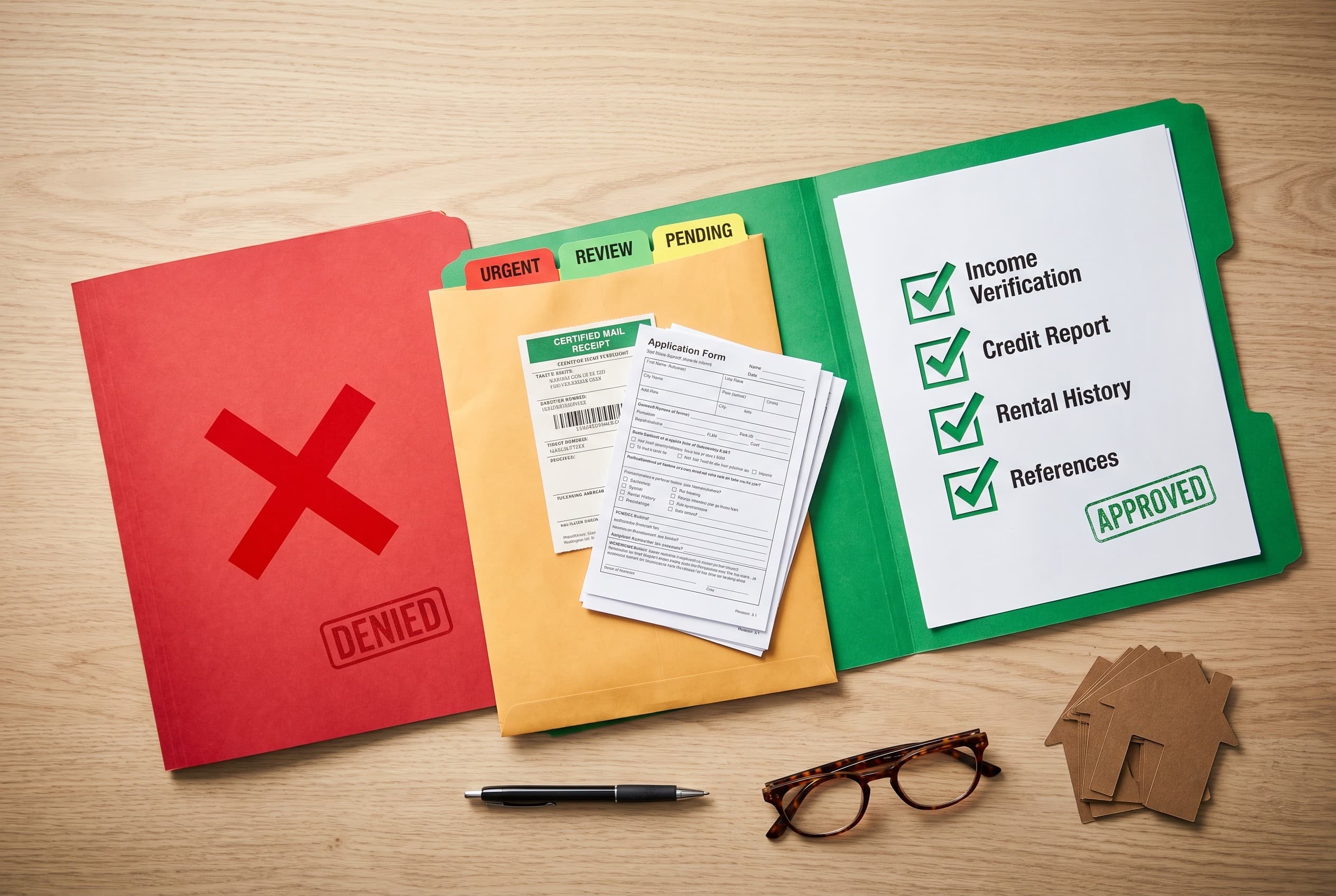
The Real Answer: Credit Score Needed to Rent an Apartment
The minimum credit score to rent an apartment usually sits at 620-650 for standard, mid-range complexes. Break it down by property type and it looks like this:
- Luxury / class-A buildings: often 680-720+
- Standard mid-tier complexes: typically 620-650
- Smaller private landlords / mom-and-pop rentals: frequently no hard score cutoff
- Second-chance or income-based housing: may accept 500s with conditions
Real talk — there's no federal law that sets a "rental minimum." Every landlord picks their own bar. A big corporate property management company runs everyone through the same automated screening system. A guy renting out his old condo might just want to make sure you're not a felon and you make three times the rent.
And here in Central Florida, the bar tends to run high. I've watched the rental market around here get vicious — people relocating for jobs at Disney, Universal, AdventHealth, Orlando Health, Lockheed Martin, all landing at once. When a place in Lake Nona or Winter Park gets 40 applications in a weekend, landlords tighten the screening screws because they can. That competition means your report has to be clean before you ever hit submit.
So when someone asks me "what's the magic number," my honest answer is: there isn't one. But 620-650 gets you in the door at most places. Below 620, you start hitting walls unless you come prepared. (More on that in a sec.)
What Actually Happens When a Landlord Runs Your Credit
Here's where most people get tripped up. They think the landlord pulls up their credit score, looks at it, and makes a yes/no call. Nope.
Most apartments use a tenant screening service — companies like TransUnion SmartMove, RentGrow, or LexisNexis. When you apply, that service pulls a specialized report that includes way more than your score:
- Your credit score (sometimes a special "rental screening score," not the same FICO your bank sees)
- Open collections and their balances
- Payment history
- Eviction filings and civil judgments (this is the killer — I'll get to it)
- Criminal background
- Prior addresses and rental history
That rental screening score explained in plain terms? It's a number a screening company generates to predict how likely you are to skip out on rent. It can be different from your regular credit score because it weighs rental-specific stuff more heavily.
And here's the operator-level detail most people never learn: these screening reports are riddled with errors. They pull from massive databases that don't get updated cleanly. An old collection that was paid. An address that isn't yours. And the big one — an eviction filing that never actually became an eviction.
The Scare: What Happens If You Just Wing It
Let's say you don't check any of this beforehand. You just apply and hope.
Best case, you get approved and you never know how close you came. Worst case? You get denied — and now you've burned an application fee ($35-$75, gone), you've got a ticking clock on your current lease, and you're scrambling.
But it gets worse. Every denial can put you in a hole where you feel pressured to sign somewhere sketchy just to have a roof. Higher deposit. Co-signer you don't have. A place you'll regret. I've seen people take a bad lease out of pure panic because they left themselves zero runway — especially folks who moved down to Kissimmee or Sanford for a new job and had days, not weeks, to lock something in.
And the absolute gut-punch? Getting denied over something that's flat-out wrong on your report. Which happens more than you'd believe.
Let me tell you about a client.
The Eviction That Wasn't
I had a client in Downtown Orlando — sharp guy, paid his rent on time his whole life. He moved out of his apartment complex the right way. Gave notice, paid every dollar he owed, handed back the keys. Clean.
Months later he applies for a new place and gets denied. The reason? An eviction filing on his record from that same Downtown Orlando complex.
Here's what happened. The complex had filed an eviction at some point during a dispute — then he paid up and moved out voluntarily. But the complex never went back and dismissed the filing. So the court record just sat there. And tenant screening companies scrape court records. They grabbed that filing and slapped it on his report like he'd been thrown out.
He hadn't been. The eviction was filed but never adjudicated — meaning no judge ever ruled on it, no eviction ever legally happened. But the screening report didn't care about that nuance. To the next landlord, it just looked like "evicted."
That's the kind of thing that'll sink you even with a decent credit score. And it's exactly why you check before you apply. I'll tell you how we killed that filing in the action plan below.
Your Legal Leverage: The Screening Company Has to Prove It
Here's what the tenant screening companies don't advertise: they're credit reporting agencies under federal law. That means they're bound by the Fair Credit Reporting Act (FCRA), same as Equifax and TransUnion.
Under the FCRA, 15 U.S.C. § 1681i, when you dispute an item on a tenant screening report, the company has to investigate — generally within 30 days (and up to 45 in some cases if you hand them extra info during the reinvestigation) — and either verify it with real proof or delete it. They can't just say "looks fine to us."
And if you get denied because of what's on that report? The landlord is legally required to give you an adverse action notice telling you which screening company they used. The CFPB spells this out — you have the right to a free copy of the report that got you denied, and the right to dispute anything wrong on it.
The FTC backs the same rights. Screening companies have to maintain accurate records. When they don't — and they often don't — that's your opening.
One more thing, and I mean this: you can dispute errors yourself, for free. You don't have to hire anyone to send a dispute letter. If your situation is simple — one wrong collection, one clear error — do it yourself and save your money. Where people bring us in is when it's tangled: a public record that won't budge, multiple bureaus, a screening company stonewalling. That's the messy stuff we handle every day.
The Action Plan: Get Approved Even If Your Score's Below the Line
OK so your score's sitting at 590 and your lease is up in three weeks. Don't panic. Here's the playbook.
1. Pull your own screening report BEFORE you apply
Don't wait for a landlord to find the surprise. Request your file disclosure directly from the big tenant screening players. If you've already been denied, you're entitled to a free copy tied to that adverse action — and many screening companies will hand you a file disclosure on request too, sometimes free depending on the situation. Either way, get eyes on it and check for:
- Collections that are paid but still showing
- Eviction filings (even ones you thought were resolved)
- Addresses or accounts that aren't yours
This is exactly where my Orlando client should've looked first. If he'd pulled his report, he'd have caught that eviction filing before it cost him an apartment.
2. Dispute anything wrong — in writing, with proof
Found an error? Dispute it directly with the screening company. Send it certified mail (yes, really — the tracking matters when you need to prove you sent it). Attach your evidence.
For my client, here's what we did: we got the landlord to confirm in writing that all rent had been paid and he'd moved out voluntarily. That letter was gold. Then we disputed the public record with that proof attached. The result? The filing got removed from LexisNexis and his tenant screening reports. No eviction hanging over him anymore.
That's the kind of work we do on the apartment denial and eviction record side — chasing down the paper that proves the record is wrong.
3. Knock out collections that are dragging your score
If you've got open collections, they hurt you two ways — they drop your score AND they show up directly on the screening report. A landlord seeing an unpaid $2,000 collection is going to worry you'll do the same to them.
Dispute inaccurate or unverifiable collections. And if a collection is legit, sometimes a pay-for-delete negotiation makes sense before you apply. That's the bread and butter of what we handle at Freedom Credit Repair.
4. Come to the application overprepared
Even with imperfect credit, you can tilt the odds. Bring:
- Proof of income showing you make 3x the rent (pay stubs, offer letter)
- Bank statements showing savings
- Reference letters from past landlords
- Offer of a larger deposit or a few months upfront
- A co-signer if you've got one available
Landlords are people. Show them you're low-risk in ways the score doesn't capture, and a lot of them will work with you. In a tight market like Altamonte Springs or Winter Park, that overprepared folder can be the thing that bumps you ahead of the other 39 applicants.
5. Know your low-credit options
If you're truly stuck, here are your rent with low credit score options:
- Private landlords who don't run corporate screening
- Second-chance apartments that specialize in credit-challenged renters
- Individual condo/house rentals through platforms where you deal with the owner directly
- Co-signer or guarantor services (they cost a fee but can get you approved)
What To Do Right Now If You've Already Been Denied
Denied already? Here are your denied apartment for credit next steps:
- Ask for the adverse action notice. The landlord must tell you which screening company they used.
- Get your free report from that company (you have the right to it after a denial).
- Read it line by line. Look for anything paid, outdated, wrong, or not yours.
- Dispute the errors with proof, certified mail.
- Reapply or apply elsewhere once the report's cleaned up — or apply now to a landlord who doesn't use that same screening service.
We get questions about this constantly — check out our FAQ for more on how disputes actually work.
Bottom Line
The credit score needed to rent an apartment usually runs 620-650, but that's a starting point, not a wall. What sinks most people isn't the score — it's the junk on their screening report they never knew was there. An old collection. A paid debt still showing. An eviction filing that never should've counted.
Check your report first. Fix what's wrong. Come prepared. And if there's a bad public record or a stubborn collection standing between you and your new place, that's a fight worth having — with the law on your side.
Talk to a Real Credit Specialist — Free
The fastest way to get straight answers about your situation in Orlando and across Florida.
4.9 · 89 Google reviews · No upfront fee
Call (407) 606-7117Individual results vary. We help you dispute inaccurate, unverifiable, or outdated items — no one can remove accurate, current information from your credit report, and you can dispute it yourself for free with the bureaus.
Lease deadline breathing down your neck? Don't wait for a denial to find out what's on your report. Call Freedom Credit Repair at (407) 606-7117 — we work with renters nationwide by phone, and we'll tell you straight whether it's something you can fix yourself for free or something we should tackle together.
Frequently Asked Questions
Can I rent an apartment with a credit score below 620?
Yes, you can rent with a score below 620, though you'll have fewer options and may need to bring extra proof of reliability. Private landlords, second-chance apartments, and individual home rentals often don't enforce a hard credit cutoff. Strengthen your application with proof of income (3x the rent), a larger deposit, past landlord references, or a co-signer. Many landlords weigh your full picture, not just the number.
What credit score do most apartments require?
Most standard apartments require a credit score of 620-650. Luxury and class-A buildings often want 680-720 or higher, while smaller private landlords may not check a score at all. There's no federal minimum — each landlord sets their own bar, so the requirement varies widely by property type and location.
Why was I denied an apartment even with good credit?
You can be denied with good credit because of what's on your tenant screening report beyond your score — most commonly an eviction filing, a civil judgment, an unpaid collection, or a background record. Tenant screening companies pull from court databases that are frequently outdated or wrong. If you were denied, request the adverse action notice, get your free screening report, and dispute any errors under the FCRA.
Is a rental screening score the same as my credit score?
Not always. A rental screening score is generated by tenant screening companies to predict rent-payment risk, and it can weigh rental-specific factors differently than the FICO or VantageScore your bank uses. That's why your screening number might not match the score you see on a free credit app.
How do I fix an eviction on my record that shouldn't be there?
Dispute it with the screening company under the FCRA, backed by proof. If the eviction was filed but never ruled on — or you paid what you owed and moved out voluntarily — get written confirmation from the landlord that the balance was cleared, then dispute the public record with that documentation attached. Screening companies like LexisNexis generally have 30 days (up to 45 in some cases) to investigate and remove records they can't verify. You can do this yourself for free, or bring in help if the record won't budge.

Matt Brody
Founder, Freedom Credit Repair
Matt is the founder of Freedom Credit Repair based in Orlando, FL. Since 2019, Matt has helped clients remove negative items from their credit reports and take control of their financial future. Call (407) 606-7117 for a free consultation. More about Matt →